

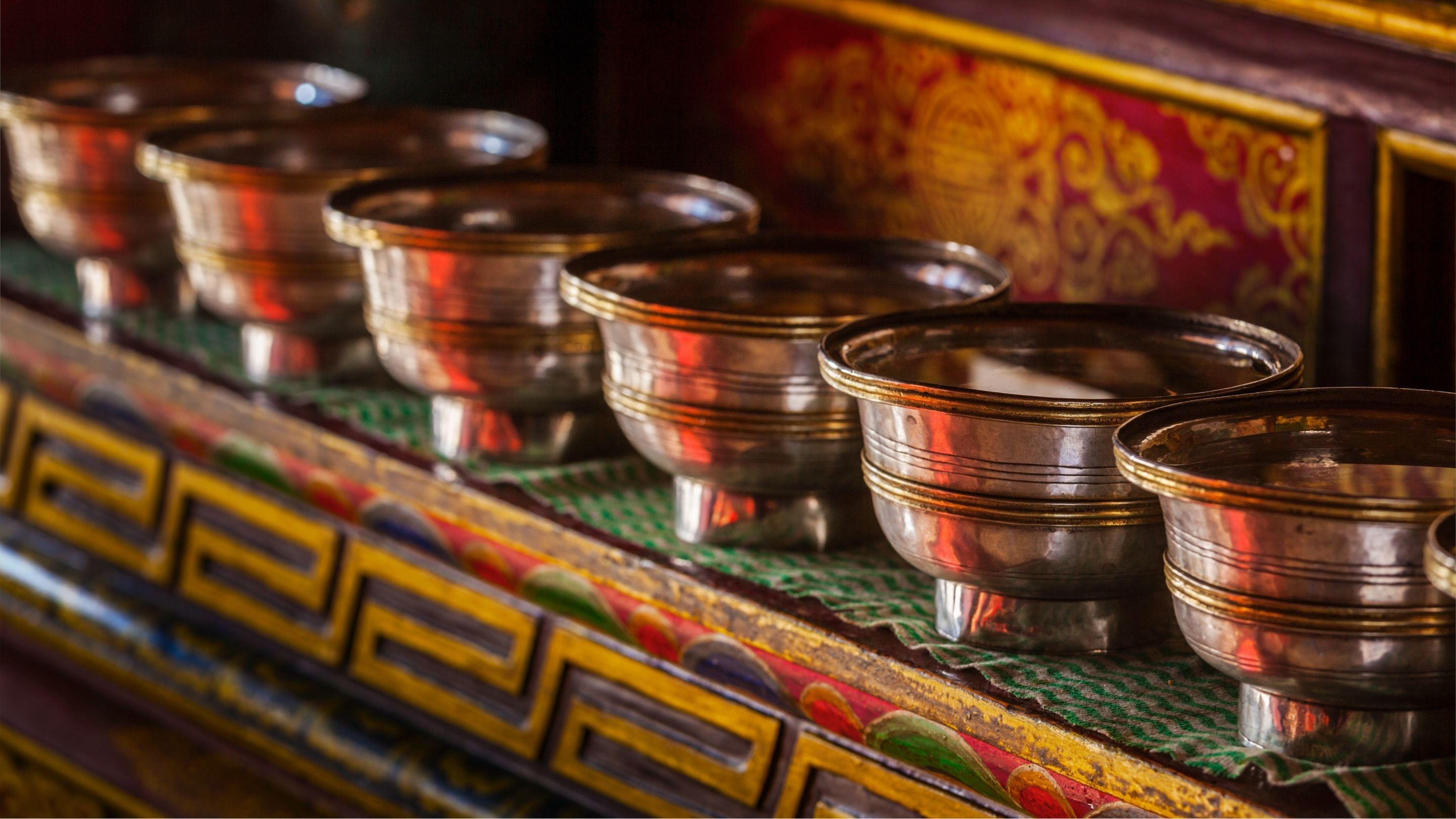
The Seven Water Bowl Offerings
A Daily Practice of Generosity and Devotion
"The value of the offering is not measured by the bowls or the water they contain, but by the generosity, devotion, and aspiration with which they are offered."
What Are the Seven Water Bowl Offerings?
The offering of seven bowls of fresh water is one of the most widespread daily practices in Tibetan Buddhism.
Each morning, practitioners prepare fresh water and offer it before the shrine as an expression of generosity, gratitude, refuge, and devotion to the Three Jewels, the lineage masters, and their teachers.
Water offerings are beautifully simple. They require no great expense, only sincerity and mindfulness. Because water is pure, freely available, and offered without attachment, it has long been regarded as one of the most perfect daily offerings.
For many practitioners, preparing the water bowls becomes the first act of Dharma each morning—a quiet ritual that turns the mind toward awakening before the activities of the day begin.
Quick Reference
Purpose:
To cultivate generosity, devotion, and mindfulness through daily offerings to the Three Jewels.
Common Materials
-
Seven offering bowls
-
Fresh, clean water
-
A pitcher or offering vessel
-
A clean cloth for preparing the bowls
The bowls themselves may be made from porcelain, copper, silver, crystal, or other suitable materials. What matters most is that they are clean, respectfully cared for, and used with sincere intention.
Why Water?
Unlike costly offerings, water is available to everyone.
It represents generosity that is offered freely and without expectation of reward.
By offering something pure each day, we gradually train the mind to become more generous, more open, and less attached.
The Buddhas do not need water.
We make offerings because the practice transforms our own hearts.
Preparing the Bowls
Before filling the bowls, many practitioners begin by preparing both themselves and the offering.
Some quietly recite the Hundred-Syllable Vajrasattva Mantra, purifying obscurations while gently wiping each bowl clean.
Rather than rushing, each bowl is handled carefully and respectfully. Even this simple preparation becomes part of the practice, bringing mindfulness into every movement.
Seeding the Bowls
One traditional method is to first "seed" the bowls.
Fill your pitcher with fresh water and pour water into the first bowl. From that bowl, place a small amount of water into each of the remaining six bowls until all seven have been lightly seeded.
Then return to the first bowl and fill each bowl in order from left to right.
This traditional method creates a smooth, mindful rhythm and reminds us that each offering is connected to the next.
Making the Offering
As the bowls are filled, many practitioners recite prayers or contemplate the qualities of the Buddha and their teachers.
Some recite the Seven Limb Prayer throughout the offering.
Others meditate on Chenrezig, their yidam, or another enlightened form while making the offerings.
At the completion of the ritual, many practitioners recite the mantra of their chosen deity over each bowl, placing the final drops of water into the offering with mindfulness and devotion.
Every lineage and practitioner develops a rhythm that reflects their own practice while remaining rooted in authentic tradition.
Tradition Note
Different Tibetan Buddhist traditions have slightly different customs for arranging, filling, and removing the water offerings.
The approach described here reflects a traditional style practiced within the Jonang lineage and familiar to students of Shar Khentrul Jamphel Lodrö Rinpoche. If your teacher has given different instructions, always follow the guidance of your own lineage.
Practice Tip
Offer Slowly
The purpose is not simply to fill seven bowls.
Allow each movement to become part of your meditation.
As you wipe each bowl, fill it, recite your prayers, and place the final drops of water into the offering, cultivate generosity, gratitude, and devotion.
Your offering begins long before the bowls are full.
How the Water Offerings Support Your Kalachakra Practice
Kalachakra teaches that every aspect of life can become part of the path to awakening.
Offering water each morning transforms an ordinary daily activity into an expression of generosity and bodhicitta. Before the demands of the day begin, you intentionally pause to remember your teachers, renew your refuge, and cultivate the aspiration to benefit all beings.
Through this simple ritual, generosity becomes a habit rather than an occasional act. Day after day, these offerings gently shape the mind toward openness, humility, and compassion.
Kalachakra Practice Lens
Water teaches without speaking.
It nourishes every living being without asking for recognition.
It adapts to every vessel without resistance.
It cleanses without judgment.
In Vajrayana, we offer water not because the Buddhas require it, but because the act of offering gradually transforms our own mind.
The outer bowls become a training in inner generosity.
Little by little, we begin offering more than water.
We offer our patience.
Our time.
Our attention.
Our compassion.
Our wisdom.
Eventually, the generosity expressed at the shrine naturally extends into every aspect of our lives.
In this way, seven simple bowls of water become a daily practice of the Bodhisattva path.
From the Teachings of Shar Khentrul Jamphel Lodrö Rinpoche
[Quotation Placeholder]
Selected from the teachings of Shar Khentrul Jamphel Lodrö Rinpoche.
Practice Reflection
Tomorrow morning, don't hurry through your water offerings.
Before the emails.
Before the phone.
Before the world asks anything of you.
Simply offer.
As you fill each bowl, allow it to become an aspiration.
May I cultivate generosity.
May I cultivate patience.
May I cultivate compassion.
May I cultivate wisdom.
If you recite prayers, let them settle gently into your heart.
If you visualize your teacher or Chenrezig, allow your devotion to grow with each bowl.
When the final drops of water are placed into the seventh bowl, pause for just a moment.
Notice the stillness.
Then carry that same spirit of generosity with you into the rest of your day.
Continue Your Journey
The seven water bowl offerings are often one of the first daily rituals that practitioners adopt, yet they remain meaningful throughout a lifetime of practice. As your understanding deepens, these simple offerings become a continual reminder that the path is cultivated through ordinary actions performed with extraordinary intention.
To learn more about authentic Vajrayana practice and the Kalachakra tradition, explore the teachings of Shar Khentrul Jamphel Lodrö Rinpoche through the Dzokden Learning Center.


