

When a Sacred Support Becomes a Support for Practice
"Consecration is not about making an object magical. It is about preparing a sacred support so that it can inspire devotion, accumulate merit, and accompany us on the path to awakening."
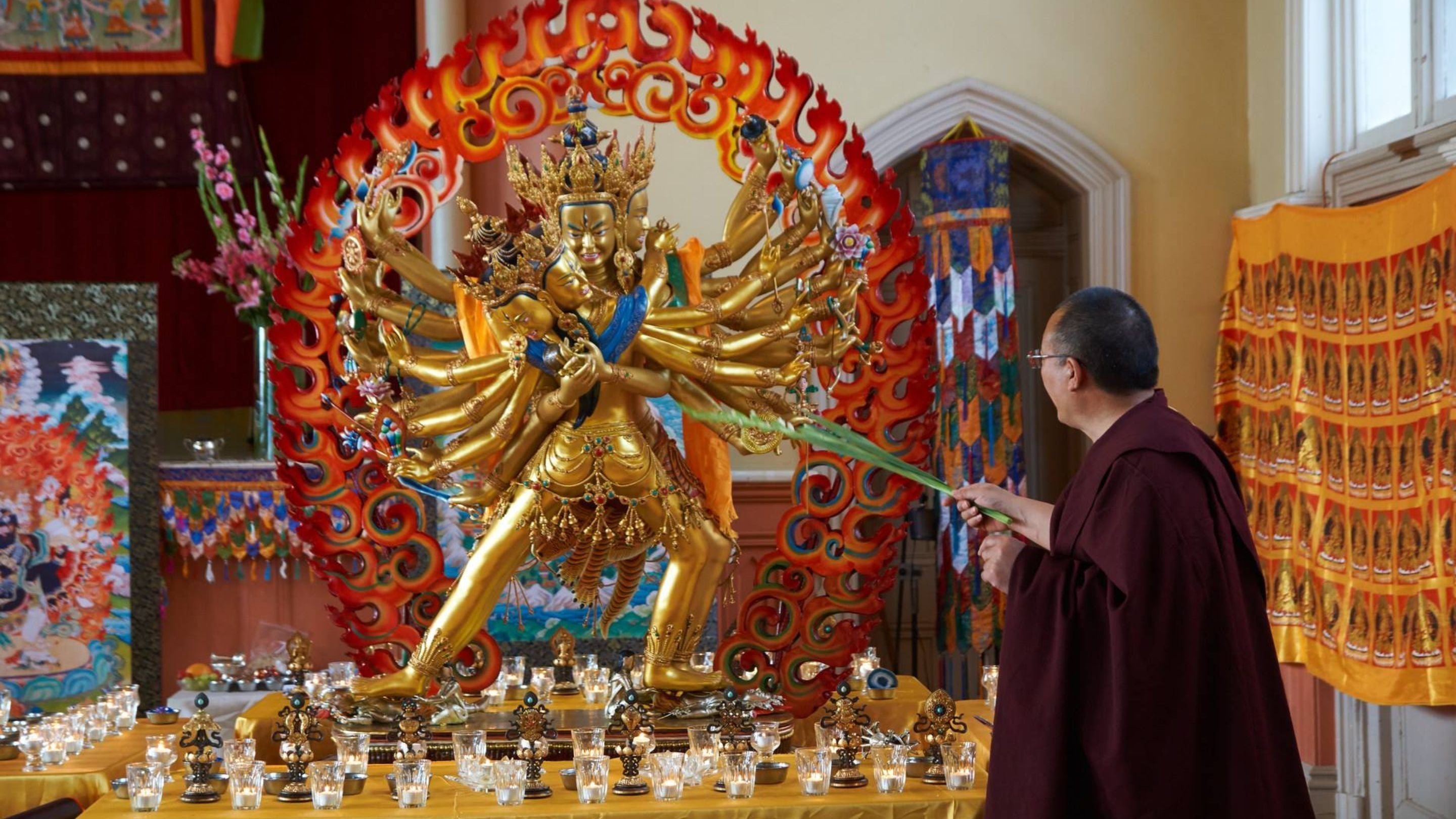
(Hero image: Shar Khentrul Rinpoche performing Rabné, blessing a statue, or consecrating sacred supports.)
What Is Rabné?
Before a statue, stūpa, prayer wheel, tsa-tsa, or other sacred support is used for Buddhist practice, it is traditionally prepared through a ceremony known in Tibetan as Rabné (rab gnas), often translated as consecration or establishing the sacred presence.
In the Vajrayana tradition, consecration is not simply a blessing performed after an object is completed. It is the culmination of careful preparation, prayers, mantra recitation, and lineage practice that establishes the object as an authentic support for awakening.
Through Rabné, an ordinary object begins a new purpose. Rather than being appreciated only for its craftsmanship or beauty, it becomes a support for refuge, devotion, meditation, merit accumulation, and the cultivation of wisdom and compassion.
Quick Reference
Purpose
To prepare sacred supports according to authentic lineage so they may assist practitioners on the path to awakening.
Sacred Supports That May Be Consecrated
-
Buddha and deity statues
-
Stūpas
-
Prayer wheels
-
Tsa-tsas
-
Ritual implements
-
Shrine objects
-
Other traditional Dharma supports
Why Consecration Matters
A sacred support is not simply something beautiful to own.
It is something we practice with.
When a sacred support is consecrated according to authentic lineage, it becomes part of a living tradition that has been transmitted from teacher to student for centuries.
As practitioners, we do not place our faith in the material itself. Rather, these sacred supports continually remind us of the Buddha, the lineage, and our own potential for awakening.
Consecration prepares them to fulfill that purpose.
Preparing a Sacred Support
Before many sacred supports are consecrated, they are traditionally prepared according to detailed lineage instructions.
Depending on the object, this preparation may include:
-
Carefully rolled mantra scrolls
-
Sacred relics
-
Blessed medicinal substances
-
Precious materials
-
Empowerment sand
-
Sacred grains
-
Protective substances
-
Other traditional contents
Each item is placed with prayers and aspiration.
Every step is performed with the intention that the sacred support become a cause for the awakening of countless beings.
The Rabné Ceremony
Once the preparation is complete, qualified lamas perform the Rabné ceremony according to traditional liturgies.
Through prayers, mantra recitation, visualization, mudrās, offerings, and lineage practices, the sacred support is formally established as an authentic object of Buddhist practice.
Its appearance may not change.
Its purpose does.
It now becomes a support through which practitioners cultivate devotion, accumulate merit, and remember their own Buddha nature.
Blessing and Consecration
Although the words are sometimes used interchangeably in everyday conversation, blessing and consecration (Rabné) are not the same.
A blessing may be given by a qualified lama to a mala, amulet, statue, text, or other sacred object. Through prayers, aspiration, and the power of the lineage, the lama strengthens the practitioner's connection to the object as a support for the Dharma.
Rabné is a traditional consecration ceremony performed according to lineage instructions to establish certain sacred supports—such as statues, stupas, and prayer wheels—as authentic supports for Buddhist practice. It often follows careful preparation, including mantra rolls, sacred substances, prayers, and ritual consecration.
Many sacred supports receive both. A statue, for example, may first be traditionally prepared and consecrated through Rabné, and later receive additional blessings from great lineage masters throughout its life.
In Vajrayana Buddhism, both blessing and consecration ultimately point to the same source: the living continuity of the lineage, transmitted from teacher to student across generations.
Question for Shar Khentrul Rinpoche: How would Rinpoche explain the difference between giving a personal blessing to a mala, amulet, or statue and performing Rabné? Is there a simple way he would like practitioners to understand the relationship between blessing, lineage, and consecration?
Living Tradition
Consecration is rarely the work of one individual.
It is often the culmination of the aspirations and efforts of an entire community.
Practitioners may spend weeks or months rolling mantra scrolls, preparing sacred substances, filling statues or stupas, making offerings, and dedicating merit before the Rabné ceremony even begins.
One recent Kālachakra project brought together volunteers from several countries to prepare 636 Kālachakra World Peace Stūpas—a number reflecting the 636 deities of the enlightened Kālachakra Maṇḍala. Together they rolled mantra scrolls, prepared sacred contents, accumulated merit, and dedicated their efforts for the benefit of all beings before the stupas were consecrated according to the Jonang lineage.
→ Read the full story in our Journal.
Practice Tip
Relate to Sacred Supports with Respect
Consecration reminds us that sacred supports are companions on the path.
Whether making an offering, cleaning your shrine, gently dusting a statue, or simply pausing before your practice, approach these supports with mindfulness and gratitude.
Respect is not offered because the object demands it.
Respect transforms the heart of the practitioner.
How Consecration Supports Your Kalachakra Practice
The Kālachakra teachings emphasize gathering both merit and wisdom as essential supports for awakening.
Consecrated sacred supports encourage both.
They remind us to make offerings.
To pause before beginning practice.
To generate bodhicitta.
To recite prayers and mantras.
To dedicate merit for all beings.
Through these repeated encounters, ordinary moments gradually become opportunities for transformation.
Kalachakra Practice Lens
Vajrayana teaches us to look beyond appearances.
A statue may appear to be bronze.
A stūpa may appear to be stone.
A prayer wheel may appear to be metal.
Yet beneath the surface lies something unseen.
Thousands of mantras rolled by hand.
Sacred substances prepared with devotion.
Blessings received through an authentic lineage.
Countless aspirations dedicated for the benefit of all beings.
Much like our own practice, the deepest transformation is often invisible.
The causes of awakening are cultivated quietly—through intention, devotion, and countless small acts performed with care.
Consecrated sacred supports gently remind us that the most meaningful qualities in life are often those we cannot see.
From the Teachings of Shar Khentrul Jamphel Lodrö Rinpoche
[Quotation Placeholder]
Selected from the teachings of Shar Khentrul Jamphel Lodrö Rinpoche.
Practice Reflection
The next time you stand before a consecrated statue, stūpa, prayer wheel, or sacred support, pause for a moment.
Rather than seeing only its material form, remember the many hands and hearts that helped prepare it.
Remember the lineage that preserved these methods.
Remember the teachers who transmitted them.
Remember the practitioners who rolled mantras, prepared sacred substances, and dedicated merit for the benefit of all beings.
Then generate your own aspiration.
May this sacred support deepen my practice.
May whatever merit arises become a cause for the awakening of all beings.
Continue Your Journey
Consecration is one expression of a living lineage transmitted from teacher to student across generations.
Learning how sacred supports are traditionally prepared can deepen both our appreciation for them and our understanding of Vajrayana practice.
Continue exploring the Journal to discover the stories behind sacred supports prepared according to the Kālachakra tradition, or deepen your study through the teachings of Shar Khentrul Jamphel Lodrö Rinpoche at the Dzokden Learning Center.
Important
Consecration methods vary according to lineage, practice, and the type of sacred support being prepared. The guidance offered here reflects general Vajrayana principles together with the Kālachakra tradition taught by Shar Khentrul Jamphel Lodrö Rinpoche. If you have received specific instructions from your own teacher or lineage, always follow those instructions.


