

TANTRIC TREASURES
PRACTICE GUIDE
THE DAMARU
Tibetan Buddhist ritual drum, Sichuan Provincial Museum. Photograph by Gary Todd, CC0.
|
A sacred support for sound, rhythm, and awakened activity This short guide introduces the damaru and its place in Vajrayana and Kalachakra practice. Specific rhythms and ritual applications should always follow your teacher and practice text. |
What Is the Damaru?
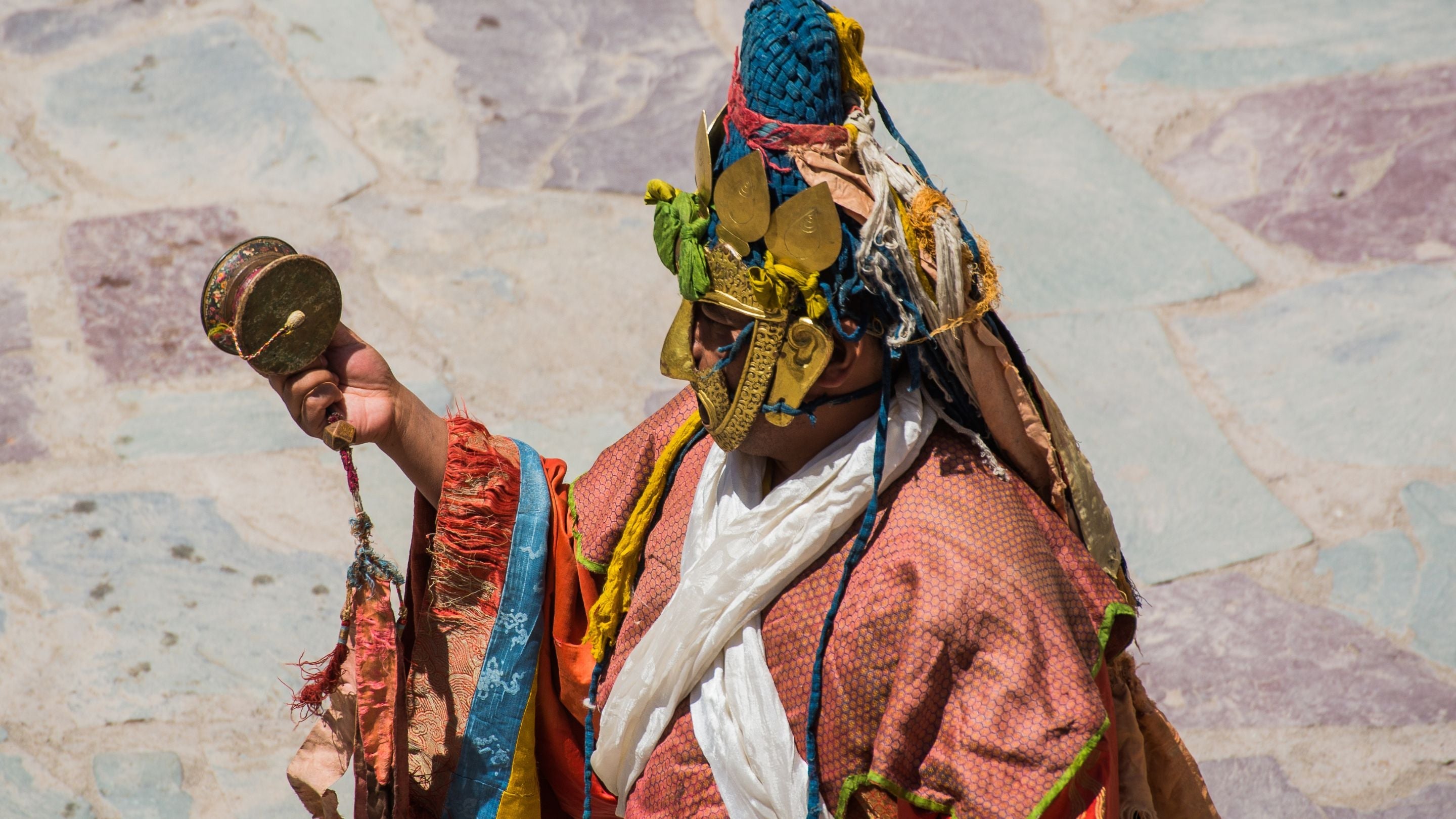
The damaru is a small, double-headed hand drum used throughout Vajrayana Buddhism. When the wrist turns the drum, two attached beaters strike the drumheads in alternation, creating a clear, pulsing sound. It is more than a musical instrument: during ritual practice, its sound can mark liturgical passages, support visualization, and express awakened activity.
The two sides of the drum are often understood as a reminder of inseparable pairs - wisdom and method, emptiness and appearance, or ultimate and conventional truth. This symbolism resonates strongly with Kalachakra, where apparently separate dimensions of experience are brought into one integrated path.
Quick Reference
|
Tradition |
Vajrayana Buddhism, including Tibetan Buddhist ritual traditions |
|
Primary purpose |
To accompany authorized liturgy and ritual activity |
|
How it is held |
Traditionally in the right hand, with a relaxed grip |
|
For Kalachakra practitioners |
Use only where indicated in the practice text or taught by the lineage teacher |
|
Care |
Keep clean, dry, elevated, and stored respectfully |
When Is It Used?
A damaru may appear in guru yoga, deity practice, feast offering, protector practice, retreat liturgies, and other Vajrayana ceremonies. The exact moments, rhythms, and meanings differ across lineages and practice texts.
Within the Jonang Kalachakra tradition, ritual instruments are part of a complete method of practice. They help body, speech, and mind enter the form and rhythm of the sadhana. When the damaru appears in a Kalachakra text, follow the notation and oral instructions received from the teacher rather than improvising.
How It Supports Your Kalachakra Practice
Kalachakra practice trains us to recognize that outer, inner, and alternative cycles are deeply interconnected. The damaru can serve as a practical reminder of this integration: sound arises, functions, and dissolves without leaving awareness.
Used with bodhicitta and lineage instruction, the drum is not merely producing rhythm. It helps gather attention, reinforces the movement of the liturgy, and participates in transforming ordinary body, speech, and mind into the path. Even when it rests on your shrine, it can recall the union of wisdom and compassionate activity.
How to Begin Using It
-
Hold the handle lightly in the right hand. Avoid gripping so tightly that the wrist becomes rigid.
-
Turn the wrist gently so the beaters strike each side in alternation. The movement should come mainly from the wrist, not the whole arm.
-
Practice slowly at first. Aim for an even sound before trying to match the pace of a group liturgy.
-
During formal practice, play only where the text or teacher indicates. Let the rhythm support the recitation rather than overpower it.
-
In group practice, listen closely and blend with the ritual leader and other practitioners.
|
|
A KALACHAKRA PRACTICE LENS Kalachakra practice trains us to recognize that outer, inner, and alternative cycles are deeply interconnected. The damaru can serve as a practical reminder of this integration: sound arises, functions, and dissolves without leaving awareness. When played with bodhicitta and lineage instruction, the drum is not merely producing rhythm. It participates in the transformation of ordinary body, speech, and mind into the path |
Eighteenth-century damaru, Metropolitan Museum of Art. CC0 / Public Domain.
Practice Tips
-
Learn the basic wrist motion before using the damaru during a full sadhana.
-
Keep the sound clear but not aggressive. The drum should support attention, recitation, and ritual timing.
-
Do not treat speed as a sign of mastery. Stability and coordination are more important.
-
When uncertain about a passage, pause and follow the umdze, chant leader, or teacher.
-
Remember the motivation: the instrument is used for awakening and the benefit of beings, not performance.
Continue Your Journey
This guide offers a practical introduction to the damaru as a support for practice. Deeper understanding develops through study, meditation, and authentic instruction.
Explore courses, teachings, and guided practices from Khentrul Rinpoche in the Dzokden Learning Center. These resources place ritual symbolism and practice within the broader view of the Jonang Kalachakra tradition.
Dzokden Learning Center: learn.dzokden.org
From the Teachings of Shar Khentrul Jamphel Lodrö Rinpoche
[Quotation Placeholder]
Selected from the teachings of Shar Khentrul Jamphel Lodrö Rinpoche.
Practice Reflection
|
Before your next practice session, hold the damaru quietly for a moment. Reflect that the purpose of every ritual implement is to awaken qualities already present within your own mind. Let the drum remind you of your aspiration to unite wisdom and compassion for the benefit of all beings. Rest for a few moments in that intention before continuing with your practice. |
Important: This guide provides general orientation only. Empowerment, transmission, practice texts, and oral instructions from a qualified teacher remain the basis for using ritual instruments in Vajrayana and Kalachakra practice.
About Tantric Treasures
Tantric Treasures offers ritual objects and practice supports for sincere Dharma practitioners, grounded in authentic lineage instruction.


