

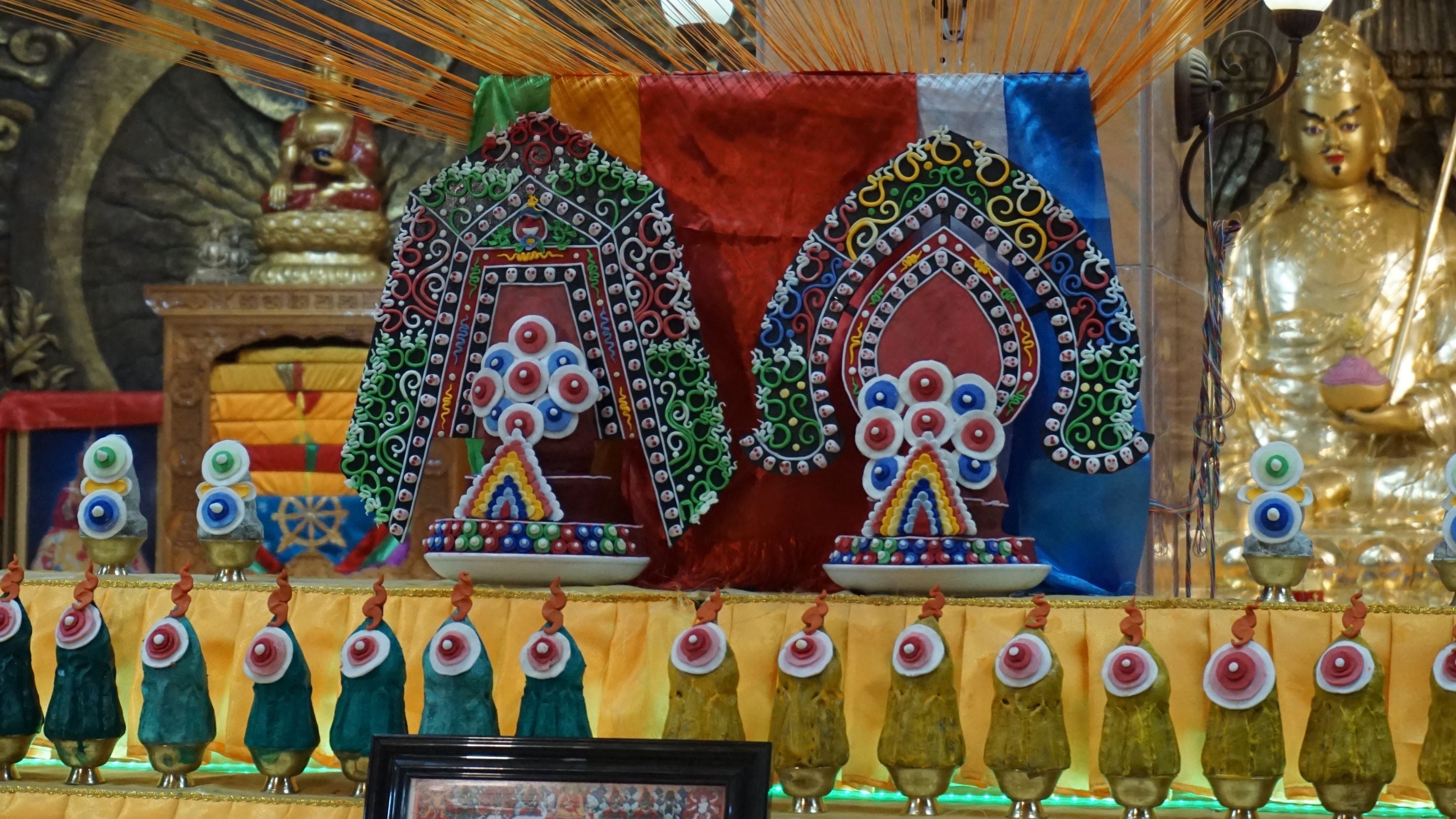
What Is a Torma?
A torma (Tib. gtor ma) is a traditional Tibetan Buddhist ritual offering. Made from simple ingredients such as roasted barley flour (tsampa), butter, honey, oats, and other natural materials, tormas have been used for centuries in Vajrayana practice as offerings of generosity, devotion, and enlightened intention.
While some tormas are beautifully decorated works of sacred art, their true purpose is not artistic display. Every torma is created as an offering—an expression of generosity, merit, and the aspiration to benefit all beings.
Throughout the Jonang Kalachakra tradition, practitioners encounter tormas in daily practice, Tsok Feasts, empowerments, pūjās, and major ceremonies.
Quick Reference
Tradition: Vajrayana Buddhism (Jonang Kalachakra)
Represents: Sacred offering, generosity, transformation, accumulation of merit
Common Ingredients:
-
Roasted barley flour (tsampa)
-
Butter
-
Honey
-
Oats
-
Natural colorings and decorations (depending on the ritual)
Common Uses:
-
Daily shrine offerings
-
Tsok Feasts
-
Pūjās
-
Empowerments
-
Protector practices
-
Mandala rituals
Two Types of Tormas
Offering Tormas
These are the tormas most practitioners encounter regularly.
Offering tormas are traditionally handcrafted from simple ingredients and placed on the shrine as offerings during practice. They may be offered during daily sādhana, protector practices, Tsok Feasts, and many other Vajrayana rituals.
Although simple in appearance, they are made with care and respect, reminding practitioners that generosity begins with offering whatever we have with a sincere motivation.
(Supporting image: Traditional offering tormas on a shrine or Tsok table.)
Mandala Tormas
Mandala tormas are among the most beautiful ritual creations in Vajrayana Buddhism.
Carefully constructed according to traditional instructions, they are unique to particular deities, empowerments, and ritual cycles. Every shape, color, ornament, and proportion carries symbolic meaning within the sacred mandala.
Within the Jonang tradition, elaborate mandala tormas are created for major empowerments and ceremonies, helping establish the complete sacred environment in which the practice unfolds.
These extraordinary offerings require many hours of careful craftsmanship and are themselves an offering of devotion.
Practice Tip
Offer with Intention
The value of a torma is never measured by its size or artistic complexity. What makes an offering meaningful is the motivation behind it. Even the simplest offering, made with genuine generosity and bodhicitta, becomes part of the path.
How Tormas Support Your Kalachakra Practice
Generosity is one of the foundational qualities cultivated on the Buddhist path.
Offering a torma is not about giving something away to a deity who needs it. The Buddhas lack nothing.
Instead, the act of offering transforms our own mind. It softens attachment, cultivates abundance, and reminds us to dedicate all positive qualities for the benefit of others.
Each offering becomes an opportunity to practice letting go while strengthening the aspiration for awakening.
Kalachakra Practice Lens
At first glance, a torma appears to be made from ordinary things.
Barley flour.
Butter.
Honey.
Simple ingredients found in everyday life.
Yet through intention, generosity, mantra, visualization, and blessing, these ordinary materials become sacred offerings.
This reflects one of the central principles of Vajrayana practice.
The path is not about rejecting ordinary life in search of something elsewhere. Rather, through wisdom and compassion, ordinary appearances become the path itself.
A handful of flour becomes an offering.
An ordinary room becomes a mandala.
Our ordinary body becomes the body of the deity.
Our ordinary speech becomes mantra.
Our ordinary mind reveals its awakened nature.
Every torma quietly reminds us that the sacred is not separate from our everyday experience. Through sincere practice, what once appeared ordinary becomes an expression of enlightened intention.
From the Teachings of Shar Khentrul Jamphel Lodrö Rinpoche
[Quotation Placeholder]
Selected from the teachings of Shar Khentrul Jamphel Lodrö Rinpoche.
Practice Reflection
The next time you see a torma, pause before admiring its beauty.
Instead, consider the intention behind its creation.
Reflect on the care, generosity, and devotion that transformed simple ingredients into a sacred offering.
Then ask yourself:
What ordinary parts of my own life could I offer on the path today?
Perhaps your time.
Perhaps your patience.
Perhaps your kindness.
Like the humble ingredients of a torma, even the simplest offering can become something extraordinary when dedicated to the benefit of all beings.
Dedicate the merit of your practice:
May every act of generosity become a cause for awakening. May all beings be free from attachment, cultivate boundless compassion, and swiftly attain complete enlightenment.
Continue Your Journey
Tormas are among the most beautiful expressions of Vajrayana ritual and devotion. Their deeper symbolism unfolds through authentic practice, study, and guidance within the living lineage.
The Decorative Elements
The forms, colors, and symbolism of tormas vary according to the deity, ritual, and lineage. While anyone may respectfully appreciate their beauty and meaning, creating or using specific ritual tormas is traditionally learned through qualified instruction within the Vajrayana tradition. There are also tormas that can be made as offering tormas by what you find inspiring and beautiful. Experiment and add your own jewels flowers and ornamentation to the tormas.


