

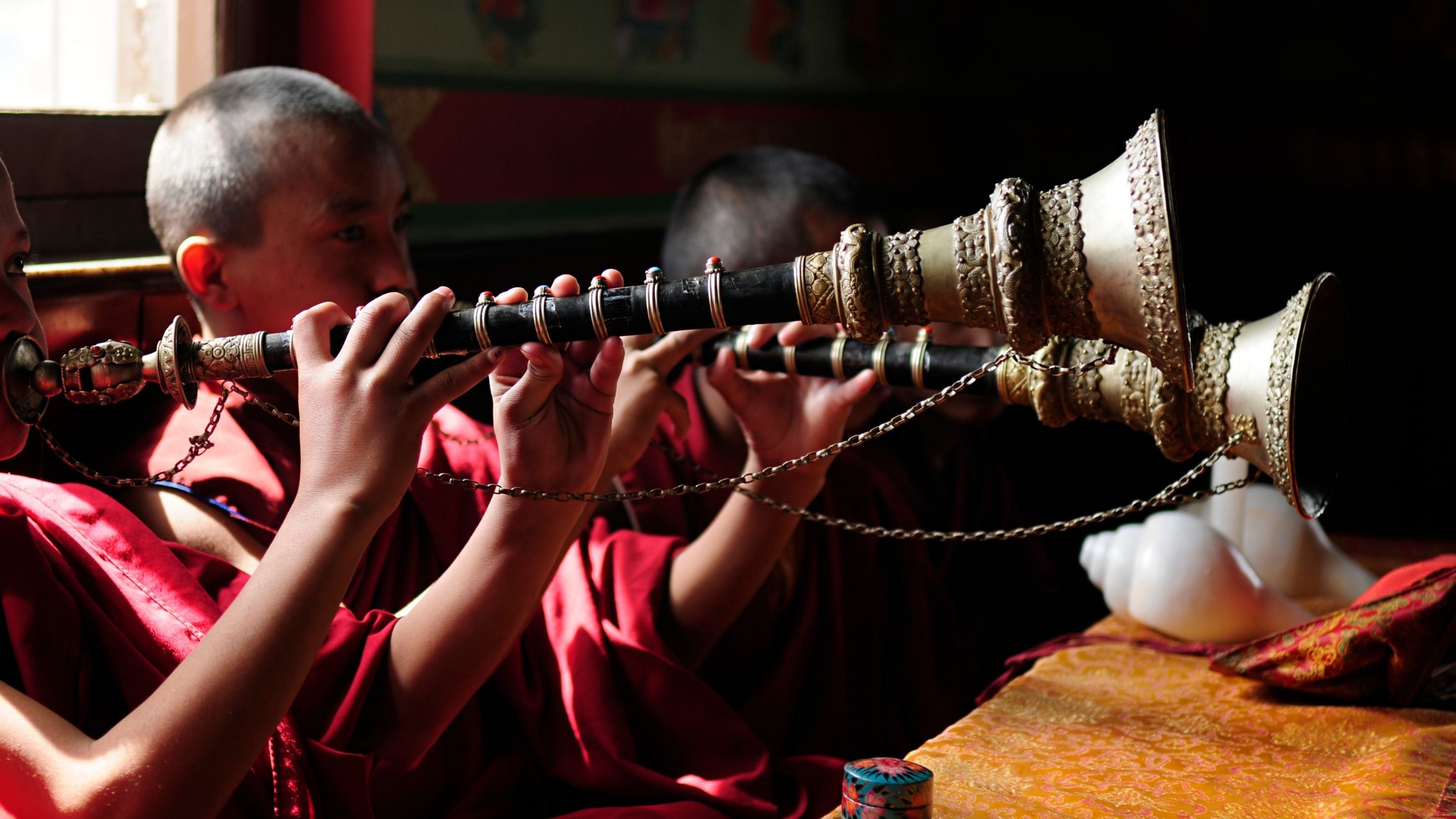
Buddhist Ritual Instruments
bài viết liên quan

The Tantrika's Vajra and Bell
The Inseparable Union of Compassion and Wisdom "The vajra and bell are never meant to be separated. Together they remind us that compassion and wisdom arise as one." What Are the Vajra and Bell? The vajra (Skt. vajra; Tib. dorje) and bell (Skt. ghaṇṭā; Tib. drilbu) are among the most essential ritual implements in Vajrayana Buddhism. They accompany nearly every sādhana, empowerment, offering, and ritual practice. They are traditionally held together—the vajra in the right hand and the bell in the left—and are understood as a single expression of the path rather than two separate objects. The vajra represents compassionate method (upāya), enlightened activity, and the unwavering aspiration to benefit all sentient beings. The bell represents wisdom (prajñā), the direct realization of emptiness and the true nature of reality. Together they express the inseparable union of compassion and wisdom, method and realization, bliss and emptiness. Throughout Vajrayana practice they continually remind practitioners that neither quality can accomplish awakening alone. Within the Jonang Kalachakra tradition, the vajra represents Kalachakra's enlightened compassionate activity, while the bell represents Viśvamātā, the wisdom consort of Kalachakra. Quick Reference TraditionVajrayana Buddhism (Jonang Kalachakra) Represents Vajra Compassion Skillful Means (Upāya) Enlightened Activity Bell Wisdom (Prajñā) Viśvamātā Realization of Emptiness Held Vajra — Right Hand Bell — Left Hand Traditionally Used Always together Common Uses Daily sādhana Empowerments Pūjās Offerings Mudrās Ritual recitation Meditation and visualization Reminder Always follow the ritual instructions given by your teacher and lineage. Why They Are Never Separated In Vajrayana Buddhism, the vajra and bell are traditionally never used separately. The vajra symbolizes compassionate activity and skillful means. The bell symbolizes wisdom, the direct realization of emptiness. If compassion lacks wisdom, it may be sincere but cannot fully liberate beings. If wisdom lacks compassion, realization remains incomplete because it does not naturally benefit others. Every mudrā, offering, visualization, and prayer performed with the vajra and bell reminds practitioners that awakening is the indivisible union of these two qualities. For this reason, practitioners traditionally keep the vajra and bell together both during practice and when respectfully storing them afterward. They are not regarded as two independent ritual implements, but as one inseparable support for the path. How Are They Used? Throughout Vajrayana practice, the vajra is held in the right hand while the bell is held in the left. The vajra accompanies mudrās, offerings, and enlightened activity. The bell is gently sounded during prayers, visualizations, offerings, and ritual recitation. Although each has its own symbolic function, they are always used as a complementary pair. Their movement and sound become part of the meditation itself, continually returning the practitioner to the union of wisdom and compassion. Living the Practice Keeping Wisdom and Compassion Close Highest Yoga Tantra is not practiced only during formal meditation sessions. It is a continual training to unite wisdom and compassionate activity in every moment. Traditionally, practitioners train never to separate the symbolic union of the vajra and bell. During formal practice, they are held in the hands. Outside of formal practice, many practitioners keep a respectful representation of this union close to them as a continual reminder of the path. Shar Khentrul Jamphel Lodrö Rinpoche often encourages students to keep the Dharma close throughout the day. While it is not always practical to carry ritual implements everywhere, practitioners may wear a small vajra and bell pendant, ring, or other respectful representation. The purpose is not as an ornament or talisman, but as a mindfulness support—a reminder to continually return to wisdom, compassion, and the aspiration to awaken for the benefit of all beings. Each time you notice it, pause for a moment. Remember your teacher. Remember your practice. Remember your Bodhisattva aspiration. Allow it to bring your mind back to the Dharma. How They Support Your Kalachakra Practice Within Kalachakra, every ritual implement becomes part of the path. The vajra reminds us to engage the world with immeasurable compassion. The bell reminds us to recognize that all appearances are empty of independent existence. Rather than withdrawing from appearances, practitioners learn to unite realization with compassionate activity. Every mudrā, every offering, every prayer, and every sound of the bell become another opportunity to cultivate this inseparable union. Kalachakra Practice Lens Within the Jonang Kalachakra tradition, the vajra represents Kalachakra's boundless compassionate activity while the bell represents Viśvamātā's wisdom. Neither stands alone. Together they express the indivisible union of compassion and wisdom, method and realization, bliss and emptiness. There is a beautiful teaching hidden in the iconography itself. When we perform practice, we traditionally hold the vajra in the right hand and the bell in the left. Yet when Kalachakra appears in union with Viśvamātā, their arms cross in embrace. From our perspective, Kalachakra's vajra now appears on the left, while Viśvamātā's bell appears on the right. If we then generate ourselves as Kalachakra during meditation, they once again become right and left. The perspective changes. The union never does. Whether viewed from outside or experienced from within, compassion and wisdom cannot truly be separated. They continuously support, define, and complete one another. This subtle reversal reminds us that ultimate truth does not change simply because our perspective changes. The bell also points toward a profound understanding of ultimate reality. Ultimate reality is not a blank void or a state of nothingness. Rather, it is the limitless ground from which all enlightened qualities and pure possibilities arise. Because all phenomena are empty of inherent existence, awakening is possible. Every Buddha quality already exists as potential within the nature of mind. Listen carefully to the sound of the bell. It appears clearly. It fills the space around you. Then, without needing to force it away, it naturally fades into silence. Our thoughts, emotions, perceptions, and experiences arise in exactly the same way. They vividly appear, function conventionally, and dissolve back into their empty nature. Nothing needs to be rejected. Nothing needs to be grasped. Like the two wings of a bird, wisdom and compassion must develop together. A bird cannot fly with only one wing, and neither can we progress on the path through wisdom alone or compassion alone. Wisdom reveals the true nature of reality. Compassion gives that realization purpose and expression. Together, the vajra and bell remind us that awakening is never only for ourselves. Genuine wisdom naturally gives rise to immeasurable compassion, and genuine compassion is always guided by wisdom. Rather than searching for wisdom somewhere outside ourselves, they remind us to recognize the enlightened qualities that have always been present—to unveil our sacred truth. From the Teachings of Shar Khentrul Jamphel Lodrö Rinpoche [Quotation Placeholder] Selected from the teachings of Shar Khentrul Jamphel Lodrö Rinpoche. Practice Reflection The next time you begin practice, pause before lifting the vajra and bell. Hold the vajra with the aspiration to benefit every sentient being. Ring the bell and listen carefully until the final trace of sound disappears. Notice how the sound appears vividly before naturally dissolving into silence. In the same way, thoughts, emotions, perceptions, and even the sense of "I" arise through causes and conditions while lacking any fixed or independent essence. Reflect that genuine wisdom naturally gives rise to compassion, and genuine compassion is always guided by wisdom. Then carry that understanding with you into the rest of your day. Whether you keep a small representation of the vajra and bell with you or simply remember their meaning, allow every reminder to return your mind to the inseparable union of wisdom and compassion. Dedicate the merit of your practice: May immeasurable compassion and perfect wisdom arise inseparably within myself and all beings. May all beings awaken to their true nature and swiftly attain complete enlightenment. Continue Your Journey The deepest meaning of the vajra and bell unfolds through authentic Vajrayana practice under the guidance of a qualified teacher. To deepen your understanding of the Kalachakra path and Vajrayana ritual practice, explore the teachings of Shar Khentrul Jamphel Lodrö Rinpoche through the Dzokden Learning Center, where these symbols are explained within the living Jonang lineage. Important The vajra and bell are traditionally used together within Vajrayana practice following empowerment (abhiṣeka), reading transmission (lung), and oral instruction (tri). While anyone may respectfully appreciate their symbolism, their deeper ritual use is learned through authentic lineage transmission.
Tìm hiểu thêm
Secrets of the Damaru
TANTRIC TREASURES PRACTICE GUIDE THE DAMARU Tibetan Buddhist ritual drum, Sichuan Provincial Museum. Photograph by Gary Todd, CC0. A sacred support for sound, rhythm, and awakened activity This short guide introduces the damaru and its place in Vajrayana and Kalachakra practice. Specific rhythms and ritual applications should always follow your teacher and practice text. What Is the Damaru? The damaru is a small, double-headed hand drum used throughout Vajrayana Buddhism. When the wrist turns the drum, two attached beaters strike the drumheads in alternation, creating a clear, pulsing sound. It is more than a musical instrument: during ritual practice, its sound can mark liturgical passages, support visualization, and express awakened activity. The two sides of the drum are often understood as a reminder of inseparable pairs - wisdom and method, emptiness and appearance, or ultimate and conventional truth. This symbolism resonates strongly with Kalachakra, where apparently separate dimensions of experience are brought into one integrated path. Quick Reference Tradition Vajrayana Buddhism, including Tibetan Buddhist ritual traditions Primary purpose To accompany authorized liturgy and ritual activity How it is held Traditionally in the right hand, with a relaxed grip For Kalachakra practitioners Use only where indicated in the practice text or taught by the lineage teacher Care Keep clean, dry, elevated, and stored respectfully When Is It Used? A damaru may appear in guru yoga, deity practice, feast offering, protector practice, retreat liturgies, and other Vajrayana ceremonies. The exact moments, rhythms, and meanings differ across lineages and practice texts. Within the Jonang Kalachakra tradition, ritual instruments are part of a complete method of practice. They help body, speech, and mind enter the form and rhythm of the sadhana. When the damaru appears in a Kalachakra text, follow the notation and oral instructions received from the teacher rather than improvising. How It Supports Your Kalachakra Practice Kalachakra practice trains us to recognize that outer, inner, and alternative cycles are deeply interconnected. The damaru can serve as a practical reminder of this integration: sound arises, functions, and dissolves without leaving awareness. Used with bodhicitta and lineage instruction, the drum is not merely producing rhythm. It helps gather attention, reinforces the movement of the liturgy, and participates in transforming ordinary body, speech, and mind into the path. Even when it rests on your shrine, it can recall the union of wisdom and compassionate activity. How to Begin Using It Hold the handle lightly in the right hand. Avoid gripping so tightly that the wrist becomes rigid. Turn the wrist gently so the beaters strike each side in alternation. The movement should come mainly from the wrist, not the whole arm. Practice slowly at first. Aim for an even sound before trying to match the pace of a group liturgy. During formal practice, play only where the text or teacher indicates. Let the rhythm support the recitation rather than overpower it. In group practice, listen closely and blend with the ritual leader and other practitioners. A KALACHAKRA PRACTICE LENS Kalachakra practice trains us to recognize that outer, inner, and alternative cycles are deeply interconnected. The damaru can serve as a practical reminder of this integration: sound arises, functions, and dissolves without leaving awareness. When played with bodhicitta and lineage instruction, the drum is not merely producing rhythm. It participates in the transformation of ordinary body, speech, and mind into the path Eighteenth-century damaru, Metropolitan Museum of Art. CC0 / Public Domain. Practice Tips Learn the basic wrist motion before using the damaru during a full sadhana. Keep the sound clear but not aggressive. The drum should support attention, recitation, and ritual timing. Do not treat speed as a sign of mastery. Stability and coordination are more important. When uncertain about a passage, pause and follow the umdze, chant leader, or teacher. Remember the motivation: the instrument is used for awakening and the benefit of beings, not performance. Continue Your Journey This guide offers a practical introduction to the damaru as a support for practice. Deeper understanding develops through study, meditation, and authentic instruction. Explore courses, teachings, and guided practices from Khentrul Rinpoche in the Dzokden Learning Center. These resources place ritual symbolism and practice within the broader view of the Jonang Kalachakra tradition. Dzokden Learning Center: learn.dzokden.org From the Teachings of Shar Khentrul Jamphel Lodrö Rinpoche [Quotation Placeholder] Selected from the teachings of Shar Khentrul Jamphel Lodrö Rinpoche. Practice Reflection Before your next practice session, hold the damaru quietly for a moment. Reflect that the purpose of every ritual implement is to awaken qualities already present within your own mind. Let the drum remind you of your aspiration to unite wisdom and compassion for the benefit of all beings. Rest for a few moments in that intention before continuing with your practice. Important: This guide provides general orientation only. Empowerment, transmission, practice texts, and oral instructions from a qualified teacher remain the basis for using ritual instruments in Vajrayana and Kalachakra practice. About Tantric Treasures Tantric Treasures offers ritual objects and practice supports for sincere Dharma practitioners, grounded in authentic lineage instruction.
Tìm hiểu thêm
7 Water Offerings
The Seven Water Bowl Offerings A Daily Practice of Generosity and Devotion "The value of the offering is not measured by the bowls or the water they contain, but by the generosity, devotion, and aspiration with which they are offered." What Are the Seven Water Bowl Offerings? The offering of seven bowls of fresh water is one of the most widespread daily practices in Tibetan Buddhism. Each morning, practitioners prepare fresh water and offer it before the shrine as an expression of generosity, gratitude, refuge, and devotion to the Three Jewels, the lineage masters, and their teachers. Water offerings are beautifully simple. They require no great expense, only sincerity and mindfulness. Because water is pure, freely available, and offered without attachment, it has long been regarded as one of the most perfect daily offerings. For many practitioners, preparing the water bowls becomes the first act of Dharma each morning—a quiet ritual that turns the mind toward awakening before the activities of the day begin. Quick Reference Purpose: To cultivate generosity, devotion, and mindfulness through daily offerings to the Three Jewels. Common Materials Seven offering bowls Fresh, clean water A pitcher or offering vessel A clean cloth for preparing the bowls The bowls themselves may be made from porcelain, copper, silver, crystal, or other suitable materials. What matters most is that they are clean, respectfully cared for, and used with sincere intention. Why Water? Unlike costly offerings, water is available to everyone. It represents generosity that is offered freely and without expectation of reward. By offering something pure each day, we gradually train the mind to become more generous, more open, and less attached. The Buddhas do not need water. We make offerings because the practice transforms our own hearts. Preparing the Bowls Before filling the bowls, many practitioners begin by preparing both themselves and the offering. Some quietly recite the Hundred-Syllable Vajrasattva Mantra, purifying obscurations while gently wiping each bowl clean. Rather than rushing, each bowl is handled carefully and respectfully. Even this simple preparation becomes part of the practice, bringing mindfulness into every movement. Seeding the Bowls One traditional method is to first "seed" the bowls. Fill your pitcher with fresh water and pour water into the first bowl. From that bowl, place a small amount of water into each of the remaining six bowls until all seven have been lightly seeded. Then return to the first bowl and fill each bowl in order from left to right. This traditional method creates a smooth, mindful rhythm and reminds us that each offering is connected to the next. Making the Offering As the bowls are filled, many practitioners recite prayers or contemplate the qualities of the Buddha and their teachers. Some recite the Seven Limb Prayer throughout the offering. Others meditate on Chenrezig, their yidam, or another enlightened form while making the offerings. At the completion of the ritual, many practitioners recite the mantra of their chosen deity over each bowl, placing the final drops of water into the offering with mindfulness and devotion. Every lineage and practitioner develops a rhythm that reflects their own practice while remaining rooted in authentic tradition. Tradition Note Different Tibetan Buddhist traditions have slightly different customs for arranging, filling, and removing the water offerings. The approach described here reflects a traditional style practiced within the Jonang lineage and familiar to students of Shar Khentrul Jamphel Lodrö Rinpoche. If your teacher has given different instructions, always follow the guidance of your own lineage. Practice Tip Offer Slowly The purpose is not simply to fill seven bowls. Allow each movement to become part of your meditation. As you wipe each bowl, fill it, recite your prayers, and place the final drops of water into the offering, cultivate generosity, gratitude, and devotion. Your offering begins long before the bowls are full. How the Water Offerings Support Your Kalachakra Practice Kalachakra teaches that every aspect of life can become part of the path to awakening. Offering water each morning transforms an ordinary daily activity into an expression of generosity and bodhicitta. Before the demands of the day begin, you intentionally pause to remember your teachers, renew your refuge, and cultivate the aspiration to benefit all beings. Through this simple ritual, generosity becomes a habit rather than an occasional act. Day after day, these offerings gently shape the mind toward openness, humility, and compassion. Kalachakra Practice Lens Water teaches without speaking. It nourishes every living being without asking for recognition. It adapts to every vessel without resistance. It cleanses without judgment. In Vajrayana, we offer water not because the Buddhas require it, but because the act of offering gradually transforms our own mind. The outer bowls become a training in inner generosity. Little by little, we begin offering more than water. We offer our patience. Our time. Our attention. Our compassion. Our wisdom. Eventually, the generosity expressed at the shrine naturally extends into every aspect of our lives. In this way, seven simple bowls of water become a daily practice of the Bodhisattva path. From the Teachings of Shar Khentrul Jamphel Lodrö Rinpoche [Quotation Placeholder] Selected from the teachings of Shar Khentrul Jamphel Lodrö Rinpoche. Practice Reflection Tomorrow morning, don't hurry through your water offerings. Before the emails. Before the phone. Before the world asks anything of you. Simply offer. As you fill each bowl, allow it to become an aspiration. May I cultivate generosity. May I cultivate patience. May I cultivate compassion. May I cultivate wisdom. If you recite prayers, let them settle gently into your heart. If you visualize your teacher or Chenrezig, allow your devotion to grow with each bowl. When the final drops of water are placed into the seventh bowl, pause for just a moment. Notice the stillness. Then carry that same spirit of generosity with you into the rest of your day. Continue Your Journey The seven water bowl offerings are often one of the first daily rituals that practitioners adopt, yet they remain meaningful throughout a lifetime of practice. As your understanding deepens, these simple offerings become a continual reminder that the path is cultivated through ordinary actions performed with extraordinary intention. To learn more about authentic Vajrayana practice and the Kalachakra tradition, explore the teachings of Shar Khentrul Jamphel Lodrö Rinpoche through the Dzokden Learning Center.
Tìm hiểu thêm