

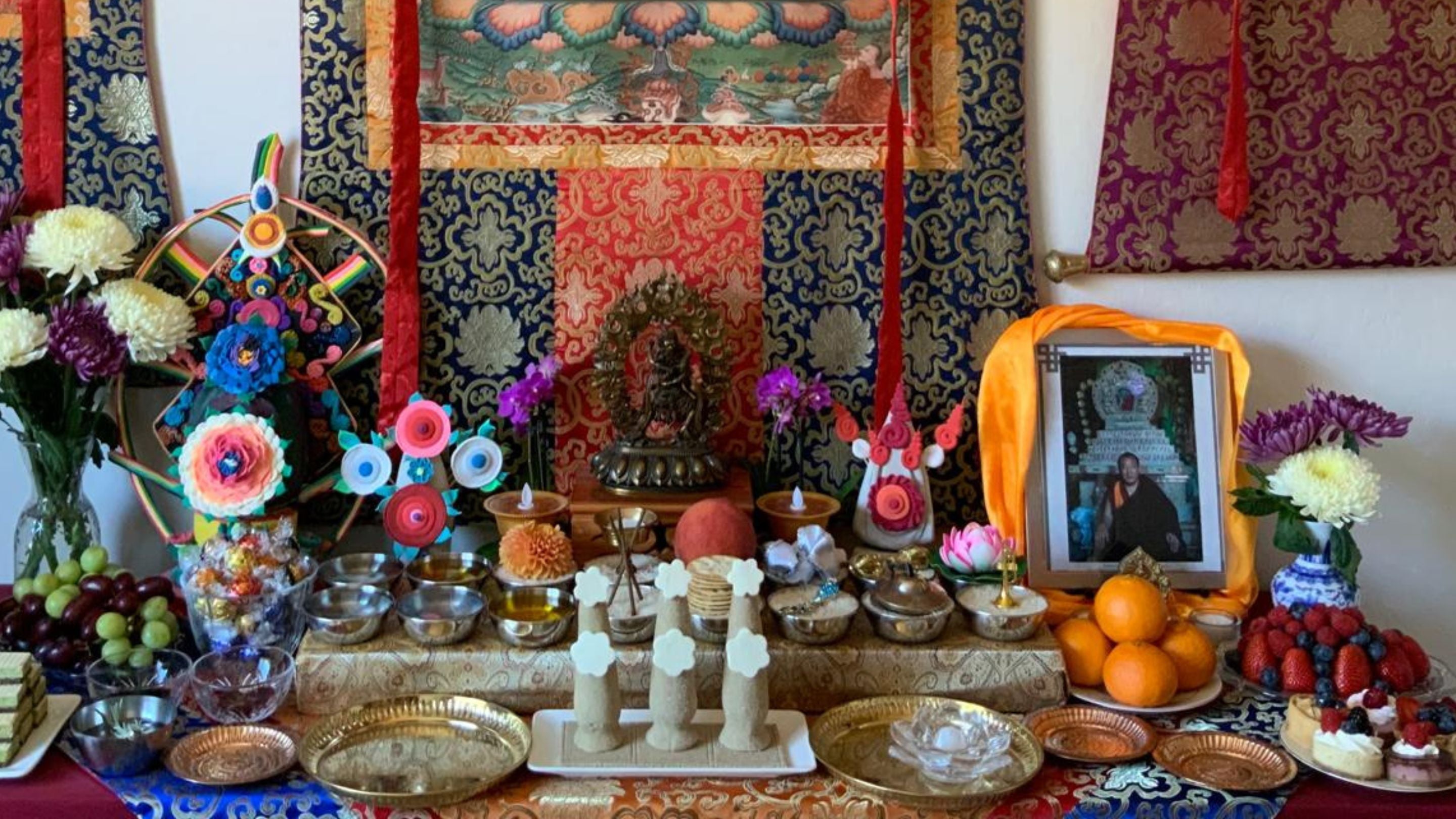
The Sixteen Offerings of Kālachakra
A Complete Offering of Generosity, Beauty, and Devotion
The Sixteen Offerings are a traditional offering set within the Kālachakra tradition. They express generosity, devotion, purification, and the aspiration to offer everything beautiful and beneficial to the enlightened beings.
What Are the Sixteen Offerings?
The Sixteen Offerings of Kālachakra are a traditional sequence of offerings presented during many Kālachakra practices and ceremonies.
You will most commonly see them prepared during a Kālachakra Tsok, but they may also be arranged for empowerments, special pujas, major ceremonies, and other important occasions within the Kālachakra tradition.
Each offering represents far more than the physical object placed on the shrine.
Together they become a complete offering of hospitality, beauty, generosity, and devotion, expressing the wish to offer everything pleasing and beneficial for the benefit of all beings.
Why Sixteen Offerings?
The sequence begins with simple acts of welcome:
-
Water for washing
-
Water for drinking
-
Fragrance
-
Refreshment
It then expands into flowers, incense, light, nourishment, beauty, music, movement, joy, and finally the offering of desirable experience itself.
Together they symbolize offering every beautiful and beneficial aspect of experience—not because enlightened beings require these gifts, but because generosity transforms the heart of the practitioner.
Arranging the Offerings
The Sixteen Offerings are arranged in two rows of eight.
When you are standing in front of the table:
-
Row One is the row closest to you.
-
Row Two is the row farther away, behind the first row.
Both rows are read from left to right.
Row One — Closest to You
The first row contains the odd-numbered offerings:
1 - Water for washing
3 - Perfume for the body
5 - Perfume for the room
7 - Incense
9 - Food
11 - Beauty
13 - Music
15 - Singing
Row Two — Farther from You
The second row contains the even-numbered offerings:
2 - Water for drinking
4 -Fragrant drink
6 -Flowers
8 -Lamp
10 -Fruit
12 -Laughter
14 - Dancing
16 -Desire

About the Arrangement
Although the offerings are physically divided into odd and even numbers, their traditional sequence remains: 1, 2, 3, 4, continuing through 16.
The two-row arrangement allows each pair to sit together from front to back:
-
Water for washing and water for drinking
-
Perfume for the body and fragrant drink
-
Perfume for the room and flowers
-
Incense and lamp
-
Food and fruit
-
Beauty and laughter
-
Music and dancing
-
Singing and desire
When standing in front of the table:
-
The row closest to you contains offerings 1, 3, 5, 7, 9, 11, 13, and 15, read from left to right.
-
The row behind it contains offerings 2, 4, 6, 8, 10, 12, 14, and 16, also read from left to right.
Beginning with water, fragrance, and refreshment before moving toward beauty, nourishment, artistic expression, and the offering of desirable experience creates a complete progression of generosity.
This keeps the offering table orderly, balanced, and easy to follow during the practice.
Practice Tip
Preparing the Offerings Is Part of the Practice
Before the ceremony begins, take time to prepare each offering with care.
Wash the bowls.
Arrange the flower.
Fill the cups.
Place each symbolic object thoughtfully.
Rather than seeing these tasks as preparation before the practice, let the preparation itself become the beginning of your practice.
As each offering is placed, cultivate the aspiration:
May this offering become a cause for purification.
May it accumulate merit and wisdom.
May it benefit all beings.
Generosity and Purification
The Sixteen Offerings express generosity, but in the Kālachakra-Jonang tradition they are also closely connected with purification.
As practitioners prepare and present these offerings, they cultivate generosity while purifying obscurations and strengthening their connection to the Vajra Master, the lineage, and the enlightened mandala.
Beautiful forms, fragrances, tastes, sounds, and experiences are no longer regarded as objects to grasp.
Instead, they become offerings.
Through generosity, what ordinarily becomes attachment is transformed into part of the path.
Kālachakra Practice Lens
The Sixteen Offerings begin with simple water.
They end with the offering of desire itself.
Nothing wholesome is excluded.
The Kālachakra path teaches that awakening does not come from rejecting the richness of experience, but from transforming our relationship to it.
When joined with bodhicitta and pure perception, every beautiful experience becomes an opportunity to practice generosity.
The offerings remind us that the world itself can become an offering.
Practice Reflection
Before the next Kālachakra ceremony, pause before the completed offerings.
Notice how each offering builds upon the last.
Water.
Fragrance.
Flowers.
Light.
Food.
Beauty.
Music.
Joy.
Reflect on what you are truly offering.
Not only the objects before you,
but your generosity,
your devotion,
your aspiration,
and your wish that all beings may awaken.
Continue Your Journey
The Sixteen Offerings are one beautiful expression of the offering tradition found throughout Vajrayana Buddhism.
To learn more about how they are used within the complete Kālachakra practices—including Tsok, empowerments, and other ceremonies—continue your study through the teachings of Shar Khentrul Jamphel Lodrö Rinpoche in the Dzokden Learning Center.


