

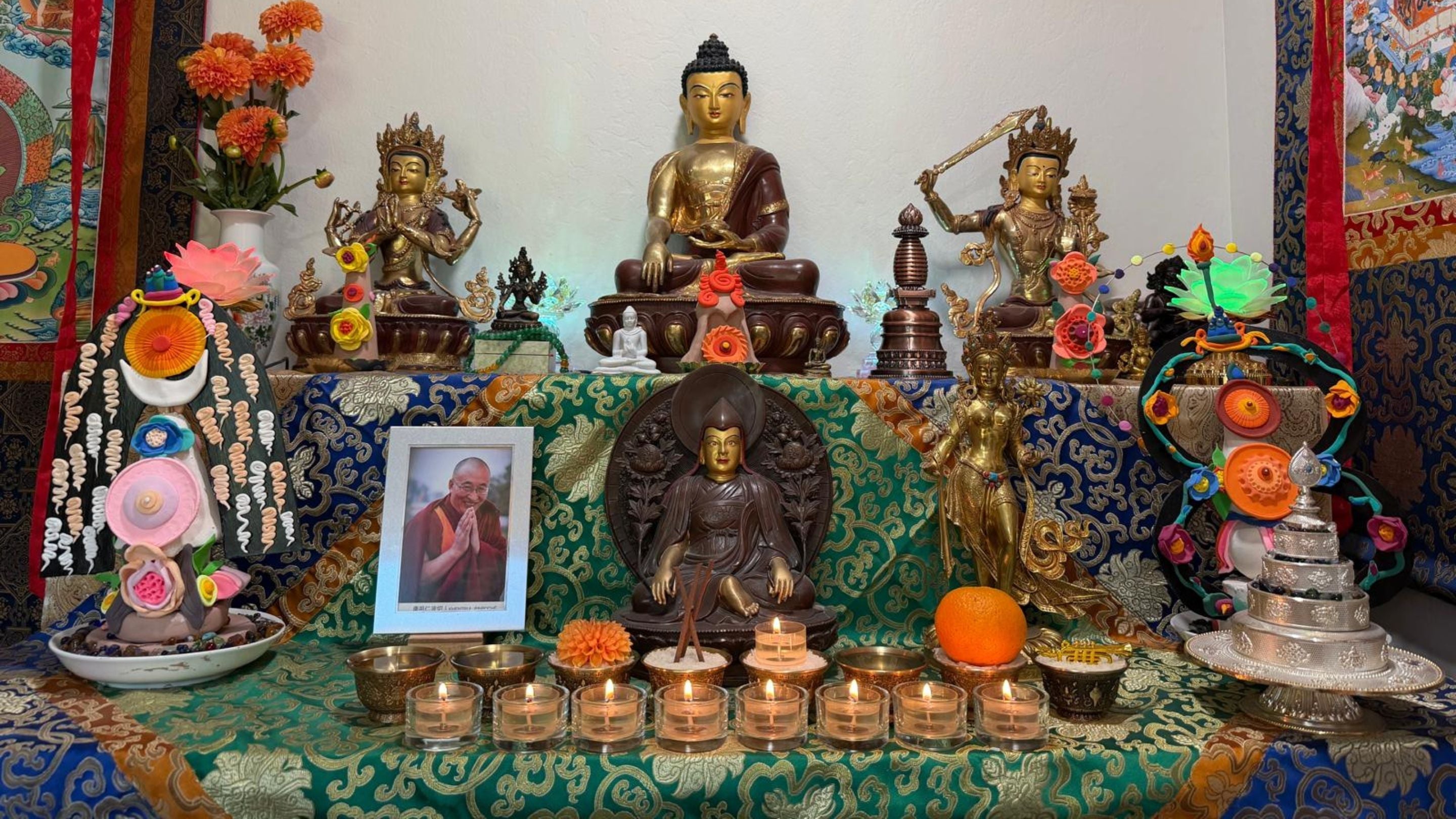
Your Home Shrine
Creating a Sacred Space for Refuge, Devotion, and Practice
"A shrine is not simply a place where sacred objects are kept. It is a place we return to—again and again—to reconnect with refuge, devotion, and our deepest aspiration."
What Is a Shrine?
A shrine is far more than a collection of sacred objects.
It is a place where you intentionally reconnect with the Three Jewels, your lineage masters, your teachers, and the awakened qualities you aspire to cultivate. It becomes a place of refuge, devotion, and daily practice.
Whether it is an entire shrine room, a small table in the corner of your home, or a simple travel shrine carried with you on pilgrimage, a shrine is a place where your mind naturally turns toward awakening.
The purpose of a shrine is not to create the "perfect" arrangement. Its true purpose is to support your practice and inspire devotion.
When you sit before your shrine, you should immediately feel connected to the lineage, to your teachers, and to the path they have preserved.
Quick Reference
Purpose:
To support refuge, devotion, meditation, and daily Dharma practice.
A Shrine May Include:
-
An image or statue of the Buddha, your yidam, or your teacher
-
Dharma texts
-
A stūpa, if available
-
Offering bowls
-
Butter lamps or candles
-
Incense
-
Flowers
-
Torma, offering and/or mandala
-
Bell and vajra
-
Mala
-
Mandala offering
-
Practice texts and ritual supports
Every shrine is unique. Build one that sincerely supports your practice.
A Shrine Can Be Anywhere
A shrine does not need to be large or permanent.
Many practitioners create a shrine on a small shelf, a table in a shared room, or a quiet corner of their home.
Others travel with a portable shrine—a small wooden box containing a treasured photograph of their teacher, a tiny tsa-tsa, a mala, or another meaningful sacred support. Wherever it is opened—in a hotel room, a retreat cabin, or a peaceful place in nature—it becomes a place to reconnect with refuge and the lineage.
What makes a shrine sacred is not its size.
It is the intention with which it is created and the devotion it inspires.
(Supporting image: A simple travel shrine or small personal shrine.)
Three Ways to Create Your Shrine
One of Shar Khentrul Rinpoche's wonderful teaching styles is to explain many aspects of practice as minimum, medium, and maximum. A home shrine can grow in the same way.
Minimum
Begin simply.
A single image of the Buddha, your teacher, or your principal deity.
A clean cloth.
One simple offering.
If this is what you have today, it is enough. What matters most is your sincere intention and your commitment to practice.
Medium
A shrine that supports regular daily practice.
It may include:
-
A Buddha or deity image
-
Practice texts
-
Offering bowls
-
Butter lamp or candle
-
Incense
-
Bell and vajra
-
Mala
-
Simple offerings
This creates a welcoming place to return to each day.
Maximum
A traditional Vajrayana shrine.
It may include representations of the enlightened body, speech, and mind, together with offering bowls, butter lamps, a stūpa, mandala offering set, prayer wheel, tormas, ritual implements, practice texts, and other sacred supports.
The purpose is not simply to own more sacred objects. Rather, each addition reflects a deepening relationship with the Dharma and supports more extensive practice.
Beginning Practice at Your Shrine
For many Vajrayana practitioners, approaching the shrine is itself part of the practice.
Before sitting down, practitioners may make three prostrations as an expression of refuge, gratitude, and respect for the Three Jewels, the lineage masters, and their teachers.
Many also take a few moments to care for the shrine before beginning practice:
-
Refreshing the water offerings
-
Replacing flowers or other offerings
-
Lighting butter lamps or candles
-
Offering incense, where appropriate
-
Tidying the shrine with mindfulness and care
These simple actions are not chores. Performed with awareness, they become part of the practice itself, cultivating mindfulness, generosity, and devotion before meditation even begins.
Practice Tip
Let Your Shrine Grow With Your Practice
Most practitioners do not build their shrine all at once. As your understanding and practice deepen, your shrine often grows naturally alongside them. Begin simply, practice sincerely, and allow your shrine to evolve over time.
How Your Shrine Supports Your Kalachakra Practice
A shrine is not created because the Buddhas need offerings.
It is created because we need reminders.
Each time we approach our shrine, we remember our teachers, generate bodhicitta, and renew our aspiration to awaken for the benefit of all beings.
Over time, the shrine becomes more than a place where practice happens. It becomes a trusted companion on the path, quietly inviting us back to refuge again and again.
Kalachakra Practice Lens
Vajrayana teaches that the outer, inner, and secret dimensions of practice support one another.
The outer shrine is the visible expression of an inner refuge.
We arrange sacred objects with care not because enlightenment exists outside ourselves, but because these supports help awaken qualities already present within our own mind.
As devotion deepens, the boundary between the shrine and daily life begins to soften.
The respect we cultivate while cleaning the shrine gradually extends to our relationships.
The generosity expressed through making offerings begins to shape how we meet others.
The mindfulness we cultivate before the shrine accompanies us into our work, our family life, and every ordinary moment.
Ultimately, the purpose of the shrine is not simply to create one sacred place in our home.
It is to train ourselves to recognize the sacred nature of all experience.
From the Teachings of Shar Khentrul Jamphel Lodrö Rinpoche
[Quotation Placeholder]
Selected from the teachings of Shar Khentrul Jamphel Lodrö Rinpoche.
Practice Reflection
The next time you pass your shrine, don't simply walk by.
Pause.
If you have a few moments, sit down.
If you are on your way somewhere, perhaps simply bow your head or make three prostrations.
Refresh the water if it needs changing.
Straighten a cloth.
Light a lamp.
Offer a moment of gratitude to your teachers and the lineage that has preserved these teachings.
Allow your shrine to become a place you return to—not only during formal practice, but throughout the rhythm of your day.
Little by little, these simple moments of connection nourish devotion, deepen refuge, and remind us of the qualities we aspire to cultivate.
Dedicate the merit of your practice:
May my home become a place of refuge, my practice benefit all beings, and may wisdom and compassion flourish throughout the world.
Continue Your Journey
A home shrine is not a destination but the beginning of a lifelong relationship with the Dharma. As your practice grows, your shrine may naturally evolve alongside it, becoming a place of refuge, study, meditation, and offering.
To deepen your understanding of authentic Vajrayana practice and the Kalachakra path, explore the teachings of Shar Khentrul Jamphel Lodrö Rinpoche through the Dzokden Learning Center.
Important
There is no single "correct" shrine for every practitioner. Traditional shrines vary according to lineage, practice, available space, and personal circumstances. What matters most is creating a respectful space that inspires devotion and supports your sincere practice.


