

The Inseparable Union of Compassion and Wisdom
"The vajra and bell are never meant to be separated. Together they remind us that compassion and wisdom arise as one."
What Are the Vajra and Bell?
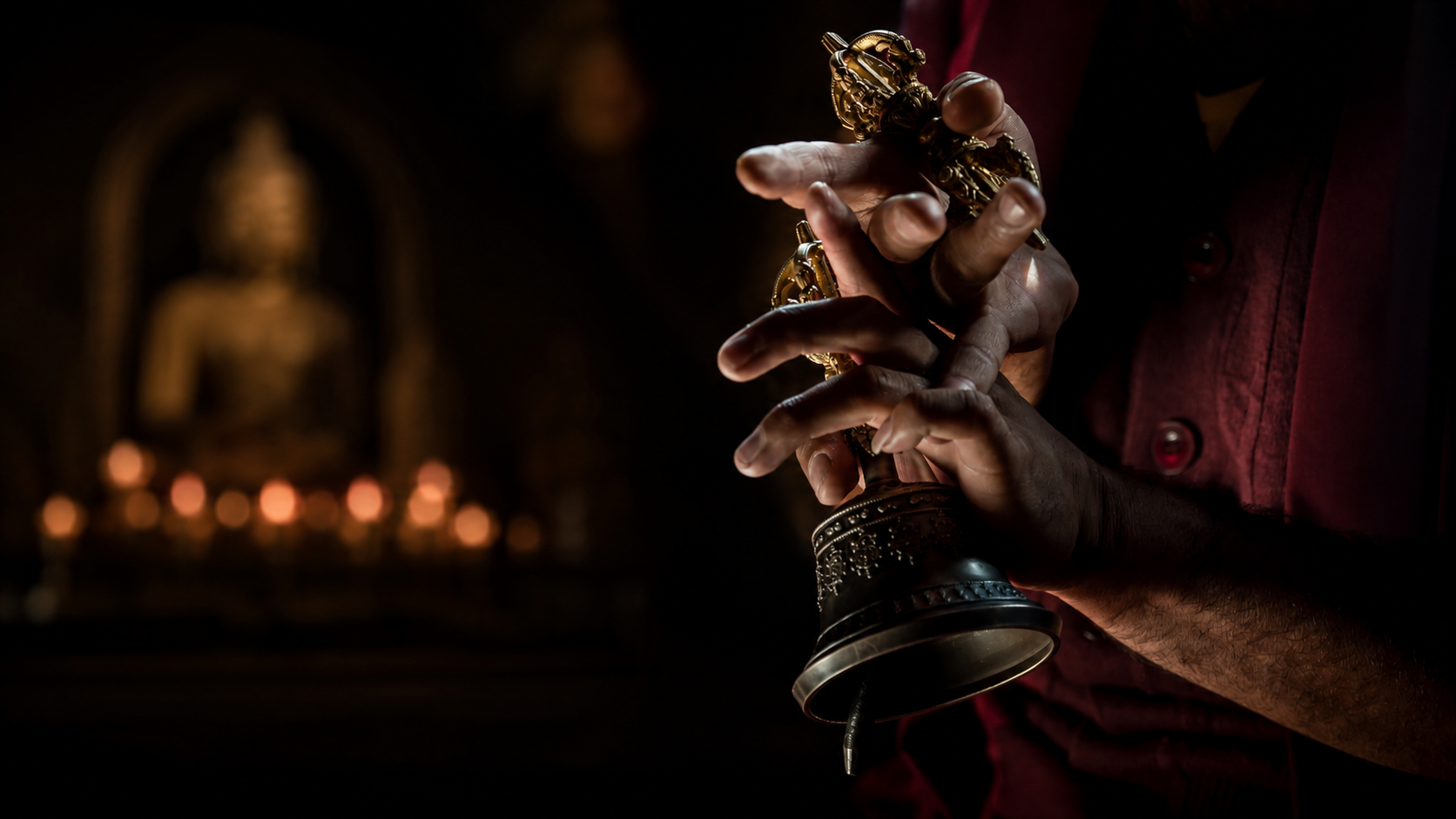
The vajra (Skt. vajra; Tib. dorje) and bell (Skt. ghaṇṭā; Tib. drilbu) are among the most essential ritual implements in Vajrayana Buddhism. They accompany nearly every sādhana, empowerment, offering, and ritual practice.
They are traditionally held together—the vajra in the right hand and the bell in the left—and are understood as a single expression of the path rather than two separate objects.
The vajra represents compassionate method (upāya), enlightened activity, and the unwavering aspiration to benefit all sentient beings.
The bell represents wisdom (prajñā), the direct realization of emptiness and the true nature of reality.
Together they express the inseparable union of compassion and wisdom, method and realization, bliss and emptiness. Throughout Vajrayana practice they continually remind practitioners that neither quality can accomplish awakening alone.
Within the Jonang Kalachakra tradition, the vajra represents Kalachakra's enlightened compassionate activity, while the bell represents Viśvamātā, the wisdom consort of Kalachakra.
Quick Reference
Tradition
Vajrayana Buddhism (Jonang Kalachakra)
Represents
Vajra
- Compassion
- Skillful Means (Upāya)
- Enlightened Activity
Bell
- Wisdom (Prajñā)
- Viśvamātā
- Realization of Emptiness
Held
Vajra — Right Hand
Bell — Left Hand
Traditionally Used
Always together
Common Uses
- Daily sādhana
- Empowerments
- Pūjās
- Offerings
- Mudrās
- Ritual recitation
- Meditation and visualization
Reminder
Always follow the ritual instructions given by your teacher and lineage.
Why They Are Never Separated
In Vajrayana Buddhism, the vajra and bell are traditionally never used separately.
The vajra symbolizes compassionate activity and skillful means. The bell symbolizes wisdom, the direct realization of emptiness. If compassion lacks wisdom, it may be sincere but cannot fully liberate beings. If wisdom lacks compassion, realization remains incomplete because it does not naturally benefit others.
Every mudrā, offering, visualization, and prayer performed with the vajra and bell reminds practitioners that awakening is the indivisible union of these two qualities.
For this reason, practitioners traditionally keep the vajra and bell together both during practice and when respectfully storing them afterward. They are not regarded as two independent ritual implements, but as one inseparable support for the path.
How Are They Used?
Throughout Vajrayana practice, the vajra is held in the right hand while the bell is held in the left.
The vajra accompanies mudrās, offerings, and enlightened activity.
The bell is gently sounded during prayers, visualizations, offerings, and ritual recitation.
Although each has its own symbolic function, they are always used as a complementary pair. Their movement and sound become part of the meditation itself, continually returning the practitioner to the union of wisdom and compassion.
Living the Practice
Keeping Wisdom and Compassion Close
Highest Yoga Tantra is not practiced only during formal meditation sessions. It is a continual training to unite wisdom and compassionate activity in every moment.
Traditionally, practitioners train never to separate the symbolic union of the vajra and bell. During formal practice, they are held in the hands. Outside of formal practice, many practitioners keep a respectful representation of this union close to them as a continual reminder of the path.
Shar Khentrul Jamphel Lodrö Rinpoche often encourages students to keep the Dharma close throughout the day. While it is not always practical to carry ritual implements everywhere, practitioners may wear a small vajra and bell pendant, ring, or other respectful representation. The purpose is not as an ornament or talisman, but as a mindfulness support—a reminder to continually return to wisdom, compassion, and the aspiration to awaken for the benefit of all beings.
Each time you notice it, pause for a moment.
Remember your teacher.
Remember your practice.
Remember your Bodhisattva aspiration.
Allow it to bring your mind back to the Dharma.
How They Support Your Kalachakra Practice
Within Kalachakra, every ritual implement becomes part of the path.
The vajra reminds us to engage the world with immeasurable compassion.
The bell reminds us to recognize that all appearances are empty of independent existence.
Rather than withdrawing from appearances, practitioners learn to unite realization with compassionate activity.
Every mudrā, every offering, every prayer, and every sound of the bell become another opportunity to cultivate this inseparable union.
Kalachakra Practice Lens
Within the Jonang Kalachakra tradition, the vajra represents Kalachakra's boundless compassionate activity while the bell represents Viśvamātā's wisdom. Neither stands alone.
Together they express the indivisible union of compassion and wisdom, method and realization, bliss and emptiness.
There is a beautiful teaching hidden in the iconography itself.
When we perform practice, we traditionally hold the vajra in the right hand and the bell in the left.
Yet when Kalachakra appears in union with Viśvamātā, their arms cross in embrace. From our perspective, Kalachakra's vajra now appears on the left, while Viśvamātā's bell appears on the right. If we then generate ourselves as Kalachakra during meditation, they once again become right and left.
The perspective changes.
The union never does.
Whether viewed from outside or experienced from within, compassion and wisdom cannot truly be separated. They continuously support, define, and complete one another.
This subtle reversal reminds us that ultimate truth does not change simply because our perspective changes.
The bell also points toward a profound understanding of ultimate reality. Ultimate reality is not a blank void or a state of nothingness. Rather, it is the limitless ground from which all enlightened qualities and pure possibilities arise. Because all phenomena are empty of inherent existence, awakening is possible. Every Buddha quality already exists as potential within the nature of mind.
Listen carefully to the sound of the bell.
It appears clearly.
It fills the space around you.
Then, without needing to force it away, it naturally fades into silence.
Our thoughts, emotions, perceptions, and experiences arise in exactly the same way. They vividly appear, function conventionally, and dissolve back into their empty nature.
Nothing needs to be rejected.
Nothing needs to be grasped.
Like the two wings of a bird, wisdom and compassion must develop together. A bird cannot fly with only one wing, and neither can we progress on the path through wisdom alone or compassion alone. Wisdom reveals the true nature of reality. Compassion gives that realization purpose and expression.
Together, the vajra and bell remind us that awakening is never only for ourselves. Genuine wisdom naturally gives rise to immeasurable compassion, and genuine compassion is always guided by wisdom.
Rather than searching for wisdom somewhere outside ourselves, they remind us to recognize the enlightened qualities that have always been present—to unveil our sacred truth.
From the Teachings of Shar Khentrul Jamphel Lodrö Rinpoche
[Quotation Placeholder]
Selected from the teachings of Shar Khentrul Jamphel Lodrö Rinpoche.
Practice Reflection
The next time you begin practice, pause before lifting the vajra and bell.
Hold the vajra with the aspiration to benefit every sentient being.
Ring the bell and listen carefully until the final trace of sound disappears.
Notice how the sound appears vividly before naturally dissolving into silence.
In the same way, thoughts, emotions, perceptions, and even the sense of "I" arise through causes and conditions while lacking any fixed or independent essence.
Reflect that genuine wisdom naturally gives rise to compassion, and genuine compassion is always guided by wisdom.
Then carry that understanding with you into the rest of your day.
Whether you keep a small representation of the vajra and bell with you or simply remember their meaning, allow every reminder to return your mind to the inseparable union of wisdom and compassion.
Dedicate the merit of your practice:
May immeasurable compassion and perfect wisdom arise inseparably within myself and all beings. May all beings awaken to their true nature and swiftly attain complete enlightenment.
Continue Your Journey
The deepest meaning of the vajra and bell unfolds through authentic Vajrayana practice under the guidance of a qualified teacher.
To deepen your understanding of the Kalachakra path and Vajrayana ritual practice, explore the teachings of Shar Khentrul Jamphel Lodrö Rinpoche through the Dzokden Learning Center, where these symbols are explained within the living Jonang lineage.
Important
The vajra and bell are traditionally used together within Vajrayana practice following empowerment (abhiṣeka), reading transmission (lung), and oral instruction (tri). While anyone may respectfully appreciate their symbolism, their deeper ritual use is learned through authentic lineage transmission.


