

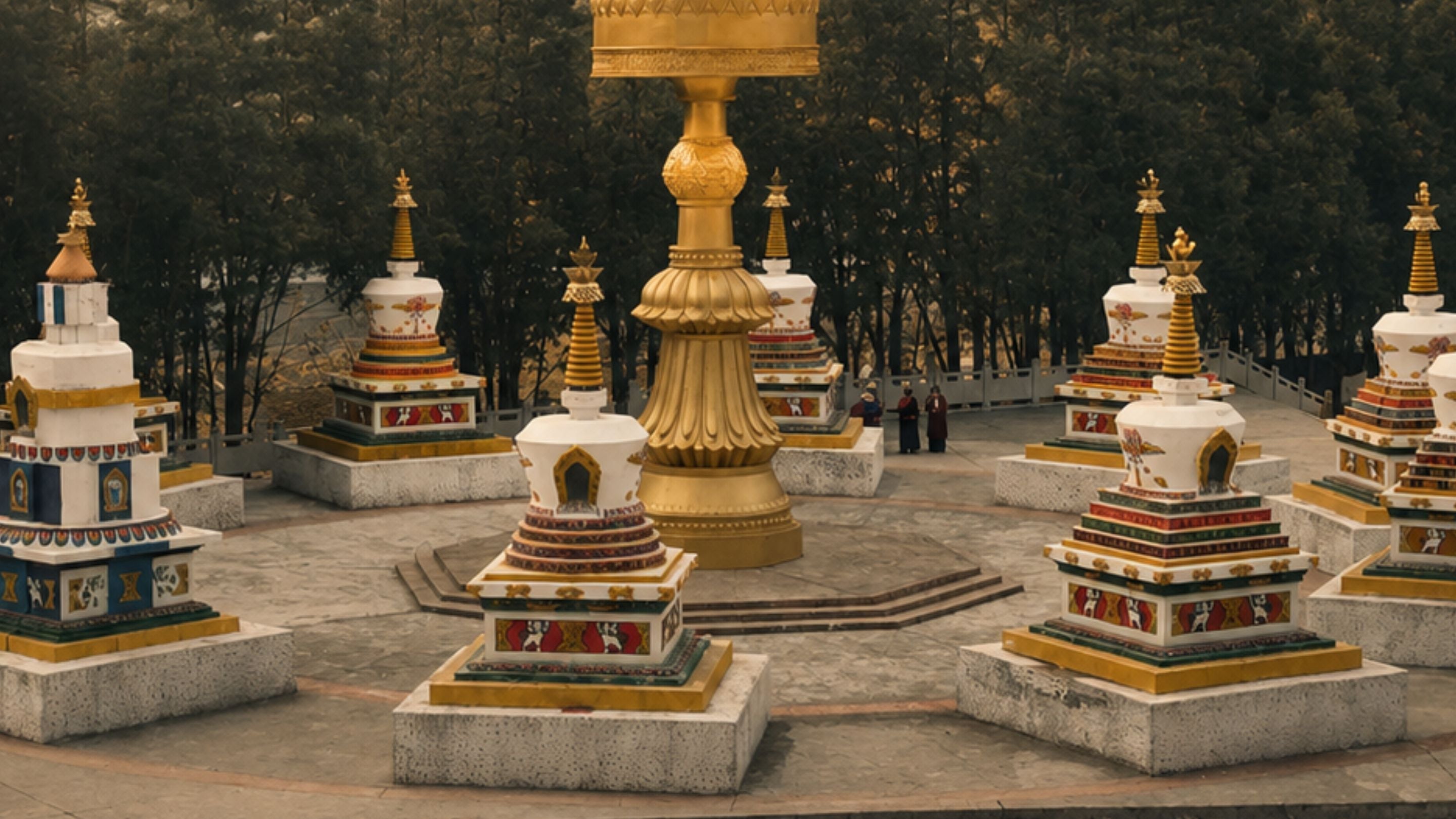
A Sacred Support for Awakening
"A stūpa is more than a monument. It is a sacred support that quietly invites us to cultivate wisdom, compassion, and the aspiration to awaken for the benefit of all beings."
What Is a Stūpa?
A stūpa is one of the most revered sacred supports in Buddhism.
For more than 2,500 years, practitioners have built, visited, and made offerings to stupas as expressions of devotion and as supports for awakening. In the Vajrayana tradition, a properly prepared and consecrated stūpa represents the enlightened body, speech, mind, qualities, and activities of the Buddha.
More than an object of beauty, a stūpa is a continual reminder of our own Buddha nature and the possibility of awakening.
Whether placed in a temple, a garden, a home shrine, or a peaceful natural setting, a stūpa becomes a place where practitioners return again and again to cultivate merit, generate bodhicitta, and dedicate their practice for the benefit of all beings.
Quick Reference
Purpose
A sacred support for refuge, merit accumulation, devotion, meditation, and awakening.
Common Practices
-
Viewing the stūpa with mindfulness
-
Circumambulating clockwise
-
Making offerings
-
Reciting prayers or mantras
-
Meditating nearby
-
Dedicating merit for all beings
Liberation Upon Seeing
In Tibetan Buddhism, stupas are often described as "liberation upon seeing" sacred supports.
Simply seeing a consecrated stūpa is considered deeply auspicious. It creates a meaningful connection with the Dharma and plants positive imprints that support the path to awakening.
Whether you pause for only a moment or spend time in contemplation, the stūpa gently reminds you of your own enlightened potential.
Circumambulate Clockwise
Walking clockwise around a stūpa is one of Buddhism's oldest devotional practices.
Traditionally, practitioners circumambulate three or more times while reciting prayers, mantras, or simply cultivating mindful awareness.
Each step becomes an opportunity to accumulate merit, purify negativity, and strengthen one's aspiration to benefit all beings.
Walk slowly.
Walk respectfully.
Allow each step to become part of your meditation.
Make Offerings
Offerings express gratitude, generosity, and devotion.
You may offer:
-
Flowers
-
Water bowls
-
Butter lamps or candles
-
Incense
-
Other traditional offerings
The offering itself is less important than the intention behind it.
As you make your offering, reflect on what you wish to purify within yourself, generate bodhicitta, and dedicate any merit toward the flourishing of the Dharma and the benefit of all beings.
Sit Nearby
A stūpa does not ask us to be busy.
Sometimes the most meaningful practice is simply to sit quietly nearby.
Rest the mind.
Recite your daily prayers.
Practice your yidam meditation.
Generate compassion.
Or simply remain present.
The stillness of the stūpa gently reminds us that awakening is found not only through activity, but also through quiet presence.
Practice Tip
Visit Your Stūpa
A stūpa is not simply something to admire from a distance.
Return to it.
Walk around it.
Make offerings.
Sit quietly beside it.
Allow it to become part of the natural rhythm of your practice.
Like a shrine, a stūpa becomes meaningful through the relationship you cultivate with it over time.
How a Stūpa Supports Your Kalachakra Practice
The Kālachakra teachings present a vision of inner and outer peace arising together.
Each time we encounter a stūpa, we are reminded to pause, generate bodhicitta, and dedicate our practice for the benefit of all beings.
In this way, the stūpa becomes far more than a sacred object. It becomes a daily invitation to cultivate the causes of the Golden Age envisioned in the Kālachakra teachings—one act of generosity, one prayer, one moment of mindfulness at a time.
Kalachakra Practice Lens
A single stūpa can transform a place.
A home becomes a place of refuge.
A garden becomes a place of contemplation.
A community gains a place where people gather to pray, meditate, and dedicate merit for the welfare of the world.
When many practitioners establish stupas throughout the world, each one becomes part of a greater aspiration.
The Kālachakra World Peace Stūpas represent this vision. Established in many countries, they invite practitioners everywhere to cultivate wisdom, compassion, and peace—not only for themselves, but for all beings.
Each stūpa becomes one quiet expression of a shared aspiration:
Peace is possible.
Peace begins within.
Living Tradition
Many Kālachakra World Peace Stūpas are traditionally filled with mantra rolls, sacred substances, relics, and other authentic contents before being consecrated according to the Jonang lineage.
One recent project brought together practitioners from several countries to prepare 636 Kālachakra World Peace Stūpas—a number reflecting the 636 deities of the enlightened Kālachakra Maṇḍala. Together they rolled mantras, prepared sacred contents, accumulated merit, and dedicated their efforts for the benefit of all beings.
→ Read the full story in our Journal.
From the Teachings of Shar Khentrul Jamphel Lodrö Rinpoche
[Quotation Placeholder]
Selected from the teachings of Shar Khentrul Jamphel Lodrö Rinpoche.
Practice Reflection
The next time you encounter a stūpa, don't simply admire it.
Pause.
Walk around it slowly.
Offer a flower, a lamp, or a simple prayer.
Sit quietly for a few moments.
Before you leave, dedicate whatever merit has arisen—not only for yourself, but for your family, your community, and all beings everywhere.
Allow the stūpa to remind you that every sincere act of practice contributes to a more peaceful world.
Continue Your Journey
Throughout the Buddhist world, stupas have inspired generations of practitioners to cultivate devotion, generosity, and wisdom.
As your practice deepens, you may find yourself returning to a stūpa again and again—not because it asks anything of you, but because it quietly reminds you of who you aspire to become.
To learn more about the Kālachakra path and the authentic Vajrayana teachings of Shar Khentrul Jamphel Lodrö Rinpoche, explore the Dzokden Learning Center.
Important
Practices associated with stupas vary slightly among Buddhist traditions and lineages. The guidance offered here reflects general Vajrayana customs together with the Kālachakra tradition taught by Shar Khentrul Jamphel Lodrö Rinpoche. If you have received specific instructions from your teacher, always follow the guidance of your own lineage.


